The mechanical properties of ductile iron cannot be expressed by a single value; tensile strength, yield strength and elongation at fracture vary with the grade in the EN 1563 standard. This article explains how to read the grade designation, its equivalents in the older GGG designation and the matrix structure that determines the properties. For what the material is and how it forms, see the article "What is ductile iron and why does it matter?".
How is the grade designation read?
In EN 1563, the grade name is written like EN-GJS-400-15. "EN-GJS" stands for spheroidal graphite cast iron, the first number gives the minimum tensile strength (MPa) and the second number the minimum elongation at fracture (per cent). EN-GJS-400-15 therefore means a minimum tensile strength of 400 MPa and an elongation at fracture of 15 %.
The grades GGG40, GGG50, GGG60 and GGG70 of the older DIN designation correspond approximately to the grades EN-GJS-400-15, 500-7, 600-3 and 700-2 respectively. The equivalence is not exact; if a specification says GGG, its equivalent should be confirmed before ordering.
Yield strength is the stress at which the material begins to deform permanently, and in design it is often more decisive than tensile strength. In ductile iron, the ratio of yield strength to tensile strength is clearly higher than in grey iron; this contributes to the part behaving more predictably under load.
Common grades and their values
When choosing a grade, looking only at tensile strength can be misleading. Two grades with the same strength may differ in ductility and machinability; the service condition of the part should be read together with these three values.
EN 1563 minimum values are for a separately cast test bar; the values in the part itself may differ according to wall thickness. As strength increases, ductility decreases.
To see the minimum values of the grades in a single table, see the Ductile iron grades and mechanical values page.
How does the matrix structure determine the properties?
Even with the same spheroidal graphite structure, the properties vary with the matrix surrounding the graphite. A ferritic matrix is softer and more ductile and easy to machine; a pearlitic matrix provides higher strength and wear resistance but reduces ductility. Lower grades are mainly ferritic, higher grades mainly pearlitic.
The matrix is adjusted through chemical composition, cooling rate and heat treatment. For applications that need higher strength, heat-treated types such as austempered ductile iron (ADI, EN 1564) are also used. The suitability of these materials is assessed separately, depending on the part and process conditions.
With heat treatment, it is possible to reach different mechanical values from the same composition. Normalising aims at a pearlitic structure and ferritising annealing at a ductile one. Because the heat treatment requirement affects both cost and lead time, it should be stated at the order stage.
Comparison with grey iron
Compared with grey (flake graphite) iron, ductile iron has higher tensile and yield strength, clear elongation at fracture and better impact behaviour. Grey iron, on the other hand, stands out in vibration damping and thermal conductivity. The two materials do not directly replace each other; which one is suitable depends on the load type.
Machinability is generally favourable in both materials. However, in high-grade pearlitic ductile iron tool wear can increase compared with ferritic grades; the machining plan should therefore be made according to the grade.
There are also differences in physical properties: the modulus of elasticity of ductile iron is clearly higher than that of grey iron, which means less elastic deformation under the same load. Vibration damping, on the other hand, is better in flake graphite iron; in vibration-sensitive bearings this difference can be decisive.
In both materials section thickness affects the distribution of mechanical properties; in thick sections the values inside the part can deviate from those of the test bar.
Conclusion: what should the grade selection be based on?
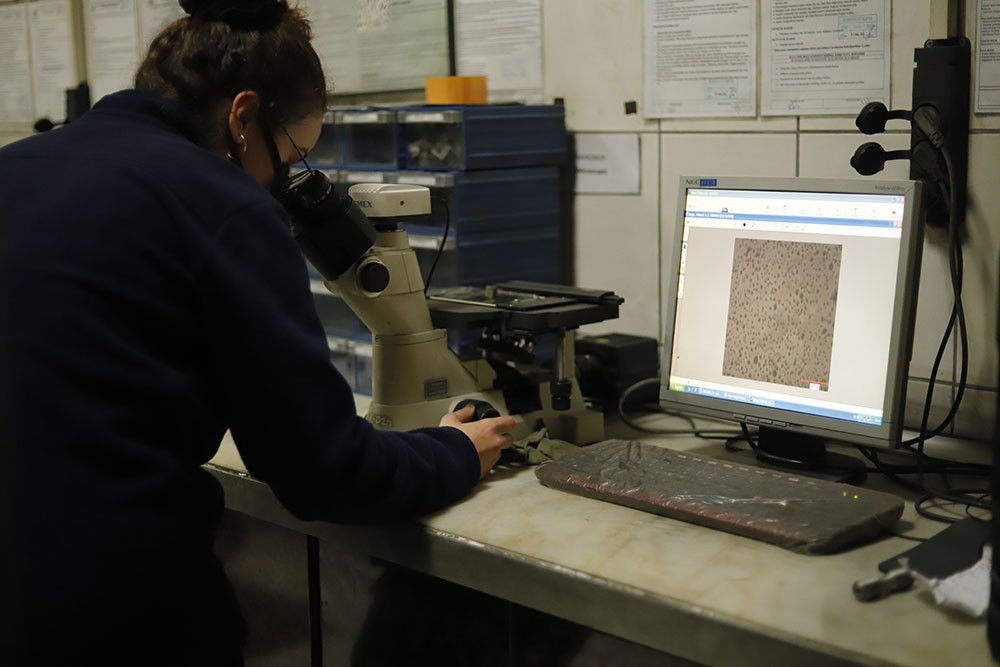
The properties of ductile iron should be read together with the EN 1563 grade and the matrix structure; the balance between tensile strength, yield strength and elongation at fracture is selected according to the load type the application requires. You can assess the suitable grade for your part with the SYC Foundry team using drawing, quantity and load information; metallurgical and metallographic checks can also be included in the scope in the Quality Control department as required.