Ductile iron is a type of cast iron in which the graphite occurs as spheres; it is also known as spheroidal graphite or nodular cast iron. This article covers the definition of ductile iron, how the spheroidal graphite structure is obtained and why designers choose this material. For grades and mechanical values, see the article "Properties of Ductile Iron".
What is ductile iron?
Ductile iron is an alloy based on iron, carbon and silicon in which most of the carbon separates out as graphite in the form of spheres (nodules). In the European standard (EN 1563) it is designated EN-GJS; the older DIN designation GGG is still widely used in the market.
One of the most important factors governing the behaviour of cast irons is the shape of the graphite. In grey (flake graphite) iron, the graphite is in the form of thin plates (flakes); the tips of these plates create stress concentrations and make it easier for a crack to start. In ductile iron the graphite is spherical, so stress is distributed more evenly; as a result the material shows higher strength and clear ductility.
In this family the carbon content is generally above 2 %, and part of the carbon separates out as graphite. Obtaining spheroidal graphite in liquid iron by adding magnesium was developed in the mid-20th century and later spread to industrial scale.
Besides the graphite, the matrix structure also determines the properties: a ferritic matrix emphasises ductility, a pearlitic matrix emphasises strength. In thick sections cooling is slow, so the nodule structure and matrix can differ from those of thin sections; for this reason section thickness is taken into account in design.
How is spheroidal graphite obtained?
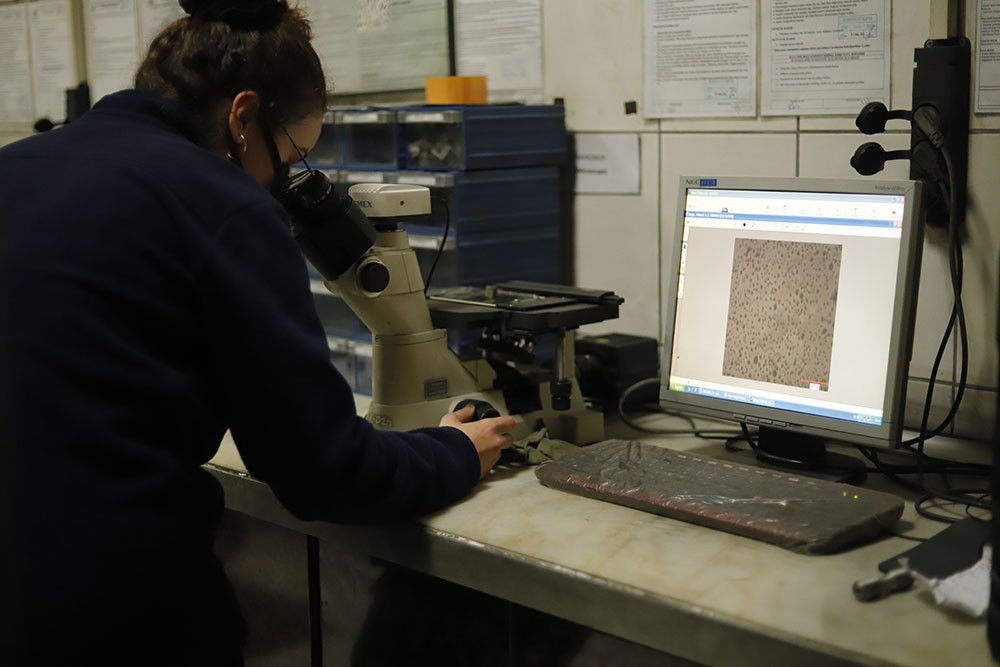
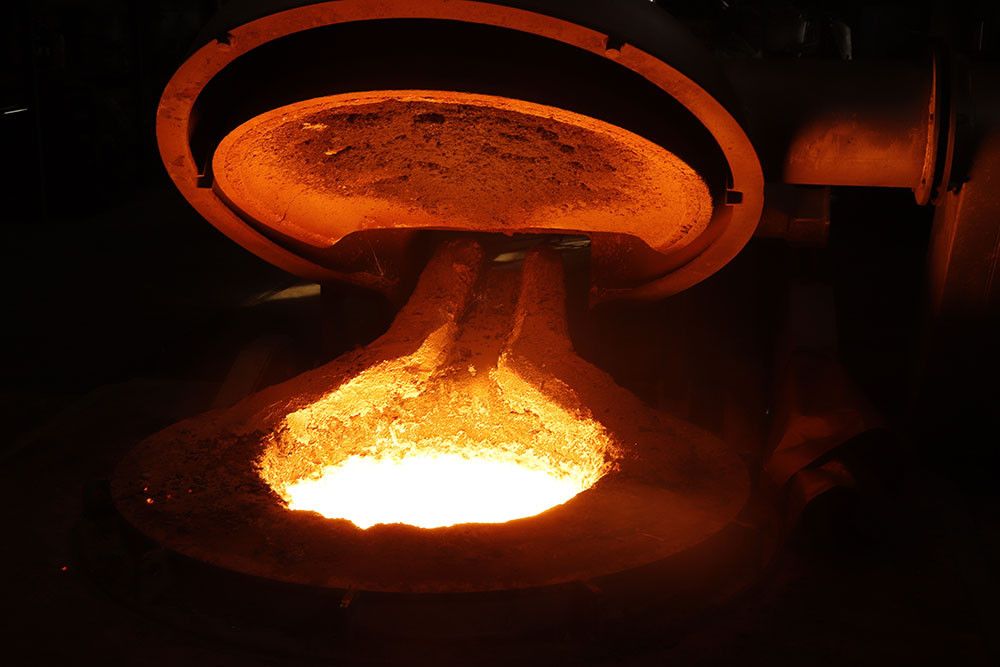
Spheroidal graphite does not form by itself; it is achieved through treatments applied to the liquid metal before casting. Because high sulphur and oxygen levels can disrupt nodularisation, composition control and metallographic examination are monitored more closely than for ordinary grey iron. In general practice, the process consists of the following stages:
- Melting and adjustment of the chemical composition: the levels of carbon, silicon, manganese and especially sulphur are controlled.
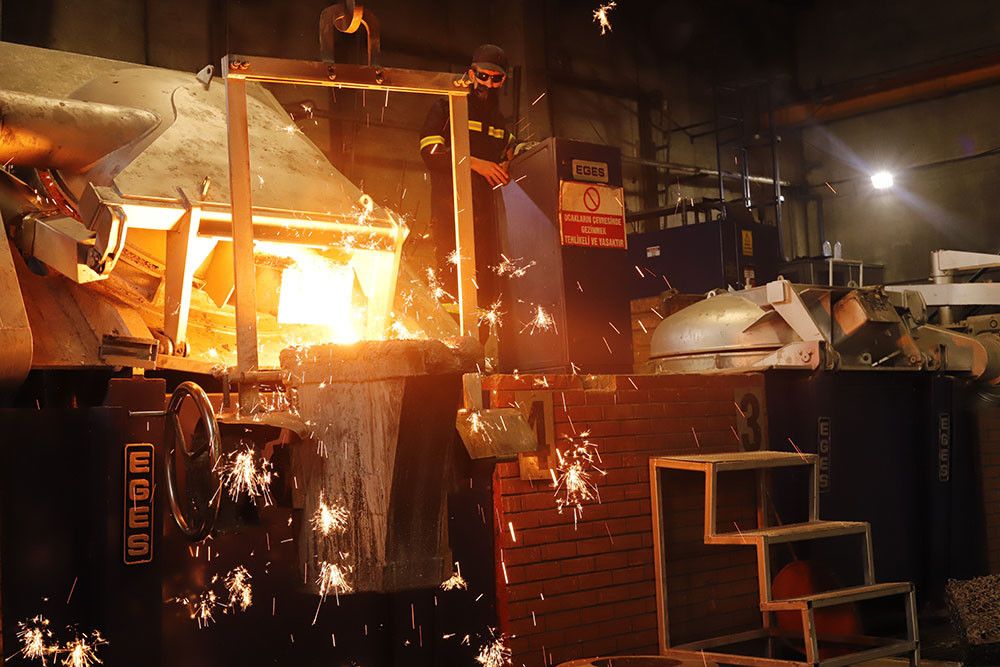
- Nodularisation: a magnesium-bearing master alloy is added to the liquid iron; this makes the graphite separate out in spherical form.
- Inoculation: graphite nucleation is promoted with a ferrosilicon-based additive.
- Pouring and solidification: because the nodularising effect fades over time, the time between treatment and pouring is kept limited.
- Heat treatment where required: applied according to the desired matrix structure and mechanical values.
Why does ductile iron matter?
Ductile iron does not describe a single material but a family of materials: a part that needs high ductility and a part that needs high wear resistance are solved with different grades. This family fills the gap between steel casting and grey iron. In general practice it appears in pump and valve housings, crankshafts, suspension and axle parts, gearbox housings and pressurised fluid fittings; the exact use depends on the load conditions of the part and the relevant specification. The main reasons that stand out for design and purchasing are the following:
- Strength and ductility are found together; it can be used where grey iron falls short in parts exposed to impact and fatigue loading.
- Castability is good; complex geometries and internal cavities can be produced as a single part with cores. Compared with steel casting, it is generally easier to cast.
- Machinability is good; this can limit machining time and tooling cost.
- Iron scrap can be used as a raw material; this is a parameter for material cost and resource use.
Should you choose ductile iron or grey iron?
The choice depends on the type of load on the part. For parts that require impact, bending and fatigue resistance, ductile iron is generally the more suitable starting point; for parts where vibration damping, compressive loading and low unit cost matter most, grey iron is generally the more suitable one.
The decision is often not made from a material table alone: wall thickness, moulding method, machining allowance and quantity also determine the cost. For this reason, re-evaluating the material choice at the pattern and casting simulation stage is a common practice.
Steel casting and forging alternatives are also considered under similar load conditions. Steel casting can offer higher strength and toughness, but because the melting temperature is high, castability and shrinkage management are more difficult; forging stands out for simple geometries and series parts that need high toughness. Ductile iron offers a balanced option where complex geometry and sufficient mechanical performance are needed together.
Conclusion: when should ductile iron be chosen?
Ductile iron is a cast iron that differs from grey iron through the spherical separation of graphite and combines strength with ductility; once the load type, geometry and quantity are clear, the material choice can be made far more soundly.
If you would like to assess the grade and process choice for your part together with the SYC Foundry team, it is enough to add a drawing attachment or a short part description to the quote form.